
What Are The Hardest Languages to Learn? [infographic]

May 18, 2011 |  by  |  Education

Bonjour! Did you catch that? That was the only French word that rolls easily off my tongue after several years of college French classes. Yes, that is pathetic. Yes, I am ashamed. This shame was only compounded when I saw today’s infographic. Apparently, the language I tried to learn is considered “easy.”

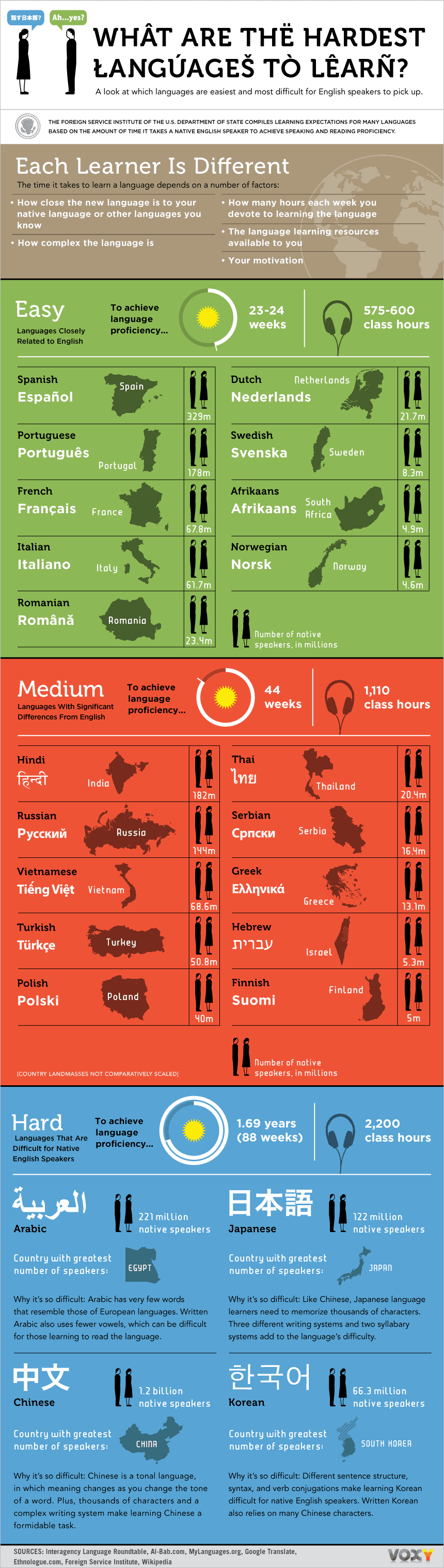
Using the Foreign Service Institute, among other sources, this infographic divides some commonly learned languages into three categories- easy, medium, and hard- based on various factors. The estimated time to achieve proficiency in each category is also included at the top of the sections. This time-frame is tempered with a reminder that each learner is different. (Learners like me and the small man in the top left of the graphic seem to have it a little harder…)

It is common sense that many Romance languages are gauged as “easy,” based on their similarity to English, but I was surprised that Russian is only “medium.” Arabic, Chinese, Japanese, and Korean comprise the list of “hard” languages to learn for native English speakers. [Via]

Infographic ranking languages by difficulty

Related Posts Plugin for WordPress, Blogger...Share This Infographic

Get Free Infographics Delivered to your Inbox

SUBSCRIBE BY RSS


  • Patamodle

    Don’t agree with Japanese: its grammar is simple, most of the sounds exist already in English or French, You need little time to be able to hold an everyday conversation. Of course, written Japanese is a formidable task, but by no means oral Japanese.
    Nice infographics anyway!

    • http://www.facebook.com/karlabravoc Karla Bravo

      I thought that it was very easy when I started learning Japanese…. now in 7th level (basic) it’s insane, because you have the 3 writing systems (kanji, katakana, hiragana) but also you have the levels of politeness (informal, formal and very formal) and 14 conjugations (present, past, continuative, conditional, etc) of course you can learn the basic stuff for travel in 3 months, but to be able to sustain a conversation is a whole different animal :D ????????

    • Jim

      No. Japanese is only easy if you are happy sounding like a 5-year-old when you speak. If you want to sound educated and like someone native Japanese people feel comfortable around, much more work is necessary.

      Many of the sounds in spoken Japanese *do not* exist in English. For example, the “u” in Japanese is not like the “ooh” sound in English nor the Spanish or Italian “u”; it’s a vowel that is so rare that there isn’t even an accepted IPA symbol for it. There are similarly unusual sounds in Japanese like the “r”, “o”, “i”, “d”, “t”, long vowels, and the list goes on. 

      The grammar is only simple if you are speaking very broken Japanese, which will hardly gain you entry into adult Japanese society. The word “eat”, for example, can be said, “kuu”, “kuimasu”, “taberu,” “tabemasu”, “meshiagaru”, “meshiagarimasu”, and on and on depending on various social factors. There are clear times when it is right and it is wrong to use these words; it’s not arbitrary. But I doubt you are even aware of these cultural nuances, given that you claimed that Japanese grammar is “simple”.

      Good luck, or perhaps I should say, “Ganbare!” (a rougher and different grammatical form of “Ganbatte!” F.Y.I.)

      P.S. I have a degree in Japanese literature and have studied the language for over 10 years, so I stand by what I write with some confidence.

  • Radosveta

    I don’t know any Japanese, but I’ve also heard it is not hard to learn. I also disagree about Russian: those declensions are really something that could put you off, even for a slavic speaker like me. I also noticed Bulagrian and German are not mentioned (since they tried to cover the European languages).  But I guess this is from an American’s point of view. Also the idea of the infogrsphic is good, and it’s well executed – since it made us read it and think, it fulfills it’s porpouse.  

  • Pepita

    Spanish easy?  22 conjugations? japanese is waaaay easier

  • Anonymous

    I, for one, do agree with Japanese being on the hard list. 
    Here`s why:

    - Each kanji has multiple readings/pronunciations.
    - Japanese is an inflective language, forcing the learner to also learn how to hear tones of voice more accurately than in, say, English which is an explicative language.
    - 3 written languages. (While Hiragana and Katakana are quite easy to learn, they are often used in conjunction with kanji).
    - Situational pronunciations (more specifically B/H)
    - The insane number of homophones.

    I will say, oral Japanese is not so bad. One can, fairly quickly, complete daily tasks with ease, but being able to get around and being able to actually converse are wildly different. 

    My other comment is:  I would like to see where English is placed in a similar list for non-native English speakers. With a lexicon much, much, larger than any other language and an irregular structure, I think it would be difficult to place it in anything other than the “Hard” category.

  • http://about.me/alexdbk Alex Debkalyuk

    Nothing new basically. :)

  • Mihai

     The Economist had an article in 2009 about languages and how hard they are to learn. They agreed on a language called Tuyuca, spoken in the Amazon. The article is here - http://www.economist.com/node/15108609

  • Pingback: EXUDATE What Are The Hardest Languages to Learn?

  • http://twitter.com/MarionCast Marion Castañeda

     Thai is “medium”? I think it’s hard, probably the same level of difficulty is Arabic.

  • Vitor

    The country with the greatest number of portuguese speakers is Brazil, with ~190 million speakers, much more than Portugal (10 million), the total number of speakers should also be higher, ~210-220 million.

  • Pingback: Culture&Moore » Blog Archive » Hardest Languages to Learn

  • Yasmine

     I guess German is not in the list because it’s extra hard? ;-) Where would you classify German?

    • J. Sands

      English is a Germanic language. German would be in the Easy zone.

    • J. Sands

      English is a Germanic language. German would be in the Easy zone.

  • Pingback: What are the hardest languages to learn? | EuropeanBuzz

  • Dimitri

    German’s probably not there because while it’s harder than those languages listed as “easy” (not -that- much harder, bit still noticeable so), it’s nowhere near as hard as those listed as “medium”. The FSI, for example, rates it (along with Indonesian and a few others) in a special sub-category of languages about 30 weeks, and I guess they thought that would disrupt the flow of the graphic or something.

  • Pingback: Caught in the Throes of More Language Woes | Hey from Japan- Notes on Moving, Emily Cannell

  • simonsaysjapan

    I have a Masters degree in Advanced Japanese, and lived there for 15 years. Believe me, it is by far the most difficult language for a native English speaker to learn. The Instiute of Linguists agree with me too, putting it at No.1. Some people here are stating that it is easy, but only because they have decided to concentrate on the easy bits and ignore the difficult, probably because they haven’t got to that stage. Japanese rarely uses the pronoun (making you wonder who is doing what to whom), has the opposite word order to English putting the verb at the end, has sometimes 26 different readings for one Kanji. Has three alphabets used together within a sentence switching them depending upon the role of the word in a sentence. There is polite Japanese, plain Japanese, and then there is honourific Keigo containing 3 honourific languages. The word for ‘I’ has at least six different words; watashi (polite), watakushi (very polite), boku (for men only, casual), ore (men only, very casual), washi (antiquated) and chin (only used by the Emperor). But then again, they often don’t use it at all. To remember the Italian for ‘flower’, I need to remember the word ‘fiore’ and in this case the words gender. For Japanese, I must remember ??,???,??,??,??,??, and the romaji of ’hana’ or the onyomi of ‘ka’. I also need to remember the brush stroke order for painting those Kanji. That is just for ‘flower’! Since Japanese also has only 46 sounds, there are so many words (made up of two Kanji) that sound identical that I must go through the different Kanji compound combinations like the rollingdrums of a slot machine until I get the word that matches the nuance. If someone says the like the English ‘kokka’ then it could mean they like England’s national flower (the red rose), the national anthem (God Save the Queen) or the political State of England. So, a Japanese might say they like the English ‘kokka’ and I might say, “Yes, I love roses too”, but they then say “Roses? Oh, no I didn’t mean the national flower, I meant the national anthem”. The Japanese are always talking at crossed purposes like this. In English the word ‘hot’ means ‘heat hot’ and ‘spicey hot’. Imagine if every word in English had several such different meanings. The Japanese themselves are often 17 before they can read a newspaper. Even then, most Japanese cannot read out loud because many of the characters have so many ways of reading them that they have to guess, and there is no rule as to which one is correct. So guys, take it from me. It is the hardest.

  • GPW

    Back in the 1970s the US Gov. tracked how long it took for smart recruits to State Department jobs to achieve an intermediate level in the immersion programs they used for the 20 or 30 languages supported. Based on the number of hours needed for native speakers of English, there were 4 classifications of difficulty level; difficult mostly for the cultural proficiency, not the linguistic production of sound or letters. In other words knowing WHEN to say WHAT to WHOM and WHICH WAY is what takes time. Category I (e.g. Spanish, French, Italian, Portuguese, Romanian), II (German, I seem to recall), III (Russian also with case endings, but different orthography than German), IV (East Asian languages, as well as Arabic).

  • h3oooooo

    What about Lithuanian? http://robertlindsay.wordpress.com/2009/12/01/more-on-the-hardest-languages-to-learn/
    Lithuanian, an archaic Indo-European Baltic tongue,
    is extremely difficult to learn.

    A single verb has 13 participial forms, and that is just using
    masculine gender for the participles. You can also add feminine forms to
    that verb. There are five classes of verbs and five models of
    declension for nouns. However, Lithuanian tense is quite regular. You
    only need to remember infinitive, 3rd person present and 3rd person past
    and after that, all of the conjugations are regular.

    There are two genders, but telling them apart is easier than in
    German where you often have to memorize which noun takes which gender.
    Lithuanian is similar to Spanish in that the ending will often give you a
    hint about which gender the noun takes.

    Here is an example of the sort of convolutions you have to go through to attach the adjective good to a noun.

    geras – good

    Masculine                   Feminine

    Singular    Plural      Singular   Plural
    Nominative    geras geri gera geros
    Genitive           gero ger? geros ger?
    Dative               geram geriems gerai geroms
    Accusative       ger? gerus ger? geras
    Instrumental  geru gerais gera geromis
    Locative           gerame geruose geroje gerose

    Lithuanian gets a 4 rating, hardest of all.

    As a learner, I can vouch for the fact that it is very difficult!

  • http://tonsofguides.net/language Joe Lingo

    It seems like virtually any language that uses characters, an English speaker will find it difficult to learn. But I guess, if you wanted to learn a language, then you’re bound to meet some kind obstacle, whether it’s a different writing system or difficult accents.

  • http://www.facebook.com/profile.php?id=1148643430 Daniel Anzures

    what about german?  X_X

  • http://twitter.com/bobmyers Bob Myers

    Written Korean does NOT rely on Chinese characters. They are hardly ever used.

    It is also not correct to say that Japanese has “three different writing systems and two syllabary systems”. There is ONE writing system, which mixes three character sets: kanji and the two syllabaries katakana and hiragana. Actually, it uses four sets if one includes romaji (Roman characters) as one should.

  • Adam

    It really bothers me how English is not widely considered a “hard” language. It is DEFFINITELY one of the hardest -if not, THE hardest-  language. It has the MOST words of any language. English may be one of the easier to initially “learn” but it is pretty much IMPOSSIBLE to master if you’re not a native speaker. 
      Just because a language uses characters does NOT make it hard… I have studied Mandarin for 4 years and it is EASY. The sentence structure is SO BASIC and it is SO easy to show tense and plurals (like simply adding “le” and “men”). To be able to speak Mandarin profficiently, you only need to know around 3,000 characters/words. Where as in English; you need to know somewhere around 20,000 words in order to be proficient. AND THAT IS NOT TO BE FLUENT!   
       With over 1,000,000 words and counting, myriads of nuances, new slang every year, more adjectives than the number of words in WHOLE languages, abbreviations, multiple meanings, strange spellings, changes in spelling for different situations, influence from EVERY language known to man, the ability to adopt words from other languages, pronunciation showing different emotions… ETC… NOTHING COMPARES TO ENGLISH!  … do you think other languages have to do vocab and spelling for years even though they already “know” the language? AND NOBODY KNOWS OLDE ENGLISH ANYMORE!!
      And as for writing… we have lower case, UPPER CASE, and cursive in lower and upper case. AND DIFFERENT FONTS!!!!!!!!!!!!!!   no other language can compare (sorry) XD

    • Anonymous

      This list is for English speakers. The list gauges the hardness of a language by comparing it to English, so the people who read this list already have mastered English. So wouldn’t it be silly to include English?

    • Tessiethecat

      You are just joking, right? Or you never attempted to learn any other language. I’m from Japan and English is my second language. I recently I completed a doctoral dessertation both in Japanese and in English. Composing something in Japanese was definitely harder. I even had to have a dictionary and other available help by my side all the time. But English was fairly easy compare to my mother language.

    • J. Sands

      Calm yourself. This is just a guide describing what languages would be most difficult for native English speakers to learn. As a native speaker of English, you don’t reserve the right to argue how difficult English might be to learn. You have no idea. I’m a native speaker, as well, and I don’t pretend to know how hard it is or proclaim my self-importance across the internet. We learned it at an age that is far different than the adult mind attempting to learn a new language. Plus, your writing skills are horrendous, and some of your points have little relevance to your argument (“DIFFERENT FONTS!!!!!!!!!!!”, really?).

  • Pingback: Gamification by Design » Quali sono le lingue più difficili da imparare?

  • Pingback: 16kinds.com – Learn Languages Better – Love and Language Learning – Does Romance Help You Learn?